Jesus is Lord
Jesus is Lord. A simple yet profound statement that we must embrace if we are to be saved:
Romans 10:8-9 (NASB) But what does it say? “THE WORD IS NEAR YOU, IN YOUR MOUTH AND IN YOUR HEART”—that is, the word of faith which we are preaching, 9 that if you confess with your mouth Jesus as Lord, and believe in your heart that God raised Him from the dead, you will be saved; (emphasis added)
The word confess here means more than just a recitation of words, but a heart and mind that are in agreement with his authority over our lives. Thus, confessing Jesus as Lord means that we are obedient to him. Indeed, Jesus questioned why those who called him Lord didn’t obey him.
Luke 6:46 (NASB) “Why do you call Me, ‘Lord, Lord,’ and do not do what I say?
Some assume or have been taught that because God and Jesus are both called Lord it is proof that Jesus is also God. But does calling Jesus Lord mean he is on an par with God? Does being Lord mean he is deity? To answer these question, let’s begin by looking at the definition of the word lord.
The Definition of Lord
The word Lord in the Greek is kurios (also spelled kyrios), and it can mean lord, master, owner and sir. It comes from the root word for authority and thus depicts one who is in authority. It is used of both God and humans. Here are several instances of those who were called kurios (and how the word is translated) in the New Testament:
- God (Lord), Luke 1:32
- husband (master), 1 Peter 3:6
- father (sir), Matthew 21:30
- slave owner (master), Matthew 10:24
- land owner (owner), Matthew 20:8
- the Roman emperor (lord). Acts 25:26
- a government official (sir), Matthew 27:63
- a term of respect when addressing a stranger (lord), John 12:21
Therefore, as we can see, Lord is not in and of itself a designation for deity.
LORD vs Lord
In the Old Testament, the word adon in Hebrew means lord, and it can be used of both men and God. It is similar in meaning to kurios in the Greek. But unlike Greek, Hebrew has a way to differentiate between lord in the general sense of human authority, and Lord when it refers to God. The word adonay (also spelled adonai), means Lord, and it is used exclusively of God. On the other hand, the word adoni, is used exclusively of human lords. For example, note how the word lord is used in the following passage when Gideon unwittingly addresses an angel:
Judges 6:13 (NASB) Then Gideon said to him, “O my lord [adoni, used of men], if the LORD [Yahweh] is with us, why then has all this happened to us? And where are all His miracles which our fathers told us about, saying, ‘Did not the LORD [Yahweh] bring us up from Egypt?’ But now the LORD [Yahweh] has abandoned us and given us into the hand of Midian.” (emphasis added)
Believing the angel to be a man,[1] Gideon respectfully refers to him as adoni, the word used exclusively for human lords. The MacArthur Study Bible agrees by noting that adoni, is used of man.[2] So we see that the Hebrew language can differentiate between a human lord (adoni) and the divine Lord (God, adonay), whereas the Greek and English languages cannot.
 Regrettably, most Bible translators have added to the confusion by substituting the word LORD for Yahweh, God’s proper name. In the previous passage we saw that LORD is used three times. However, in each case the Hebrew text actually says Yahweh (YHWH). Scholars say this substitution was made because of a “later Jewish belief ” that the name Yahweh was “too holy to utter.”[3] Martin Luther, the 15th century reformer, in his German translation of the Bible, is said to be the first person to use all capital letters to visually differentiate LORD[4] (as a substitution for Yahweh) from Lord or adonay.[5] Unfortunately, for English readers, LORD has, in a sense, become God’s name, thus helping to create the misunderstanding that Lord is as a designation for deity.
Is Lord a divine title for Jesus?
Which brings us to the question: does referring to Jesus as Lord indicate he is God? Thankfully, Scripture provides us with an answer. On the Day of Pentecost, the apostle Peter, having been filled with the Holy Spirit, stood up among the crowd and began to preach that the crucified Nazarene was the Christ (King). What’s more, Peter said this man,[6] whom God attested to by working miracles through him, had been exalted to God’s right hand:[7]
Acts 2:33 and 36 (NASB) 33 “Therefore having been exalted to the right hand of God, and having received from the Father the promise of the Holy Spirit, He has poured forth this which you both see and hear…36 “Therefore let all the house of Israel know for certain that God has made Him both Lord and Christ—this Jesus whom you crucified.” (emphasis added)
Peter, speaking by the Holy Spirit, declared that God had made Jesus Lord and Christ. In other words, Jesus was not intrinsically Lord, but because God highly exalted him to His right hand as the Christ (King) he is also Lord. Paul provides us with specific insight as to why Jesus received such an honor:
Philippians 2:8-11 (NASB) Being found in appearance as a man, He humbled Himself by becoming obedient to the point of death, even death on a cross. 9 For this reason also, God highly exalted Him, and bestowed on Him the name which is above every name, 10 so that at the name of Jesus EVERY KNEE WILL BOW, of those who are in heaven and on earth and under the earth, 11 and that every tongue will confess that Jesus Christ is Lord, to the glory of God the Father. (emphasis added)
 Paul writes that the reason for Jesus’ exaltation was because of his obedience to do the will of God, even unto death. The apostle writes nothing about Jesus being exalted because he is deity. In fact, one cannot be exalted to a position one already occupies, especially God. Furthermore, God has given Jesus the name–that is the authority–that is above every name so that everyone will bow to the Christ (King) as Lord. This act of exaltation results in glory to God the Father with no mention of the supposed Godhead or the Trinity.
Jesus also attests to this delegation of God’s authority:
Matthew 28:18 (NASB) And Jesus came up and spoke to them, saying, “All authority has been given to Me in heaven and on earth. (emphasis added)
Of significance is the fact that the authority was given to Jesus, meaning, it wasn’t something he already possessed. Moreover, this authority doesn’t make him the supreme God because, while Jesus has been designated “Lord of all,”[8] he is still in subjection to God, who is the Father:
1 Corinthians 15:27-28 (NASB) For HE [God] HAS PUT ALL THINGS IN SUBJECTION UNDER HIS [Jesus’] FEET. But when He [God] says, “All things are put in subjection,” it is evident that He [God] is excepted who put all things in subjection to Him [Jesus]. 28 When all things are subjected to Him [Jesus], then the Son Himself also will be subjected to the One who subjected all things to Him, so that God may be all in all. (emphasis added)
Even though Jesus has been exalted to such a high position, nevertheless, he is still under God’s authority so that God Himself is supreme.
Some will say that when Jesus was exalted to God’s right hand, he was simply reclaiming his place of authority after having humbled himself at his supposed incarnation. However, this post-Biblical theory is not supported by Scripture. No New Testament author says that Jesus “set aside his deity” or that “he returned to his throne” or anything even remotely similar. What is corroborated by Scripture, however, is the fact that a human was exalted as Lord of all by his God and Father.
Psalm 110:1 The Exaltation of a Human Lord
We briefly looked at Acts chapter 2 where Peter is explaining to the crowd that the risen Jesus has been exalted as Lord. Let’s look at this passage more closely for it will supply us with further clarity: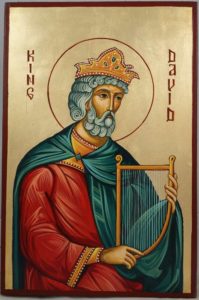
Acts 2:29-36 (NASB) 29 “Brethren, I may confidently say to you regarding the patriarch David that he both died and was buried, and his tomb is with us to this day. 30 “And so, because he was a prophet and knew that GOD HAD SWORN TO HIM WITH AN OATH TO SEAT one OF HIS DESCENDANTS ON HIS THRONE, 31 he looked ahead and spoke of the resurrection of the Christ, that HE WAS NEITHER ABANDONED TO HADES, NOR DID His flesh SUFFER DECAY. 32 “This Jesus God raised up again, to which we are all witnesses. 33 “Therefore having been exalted to the right hand of God, and having received from the Father the promise of the Holy Spirit, He has poured forth this which you both see and hear. 34 “For it was not David who ascended into heaven, but he himself says: ‘THE LORD SAID TO MY LORD, “SIT AT MY RIGHT HAND, 35 UNTIL I MAKE YOUR ENEMIES A FOOTSTOOL FOR YOUR FEET.”‘ 36 “Therefore let all the house of Israel know for certain that God has made Him both Lord and Christ—this Jesus whom you crucified.”
In verse 34, Peter quotes Psalm 110:1:
Psalm 110:1 (NASB) The LORD says to my Lord: “Sit at My right hand Until I make Your enemies a footstool for Your feet.” (emphasis added)
The first LORD, written in all capital letters, is actually the Hebrew word Yahweh and, as you know, it is God’s name. The second Lord in the passage is the word adoni which, as we’ve discussed, exclusively denotes a human lord or master. Adoni is not to be confused with the word adonay which is used for exclusively for God. Baptist seminary professor of Old Testament, Claude Mariottini, also makes note of the importance of King David’s choice of words and what they mean:
The word translated “lord” is “adoni” and should be translated “my lord.” The word is not “Adonai” which, if it had been used, would be a reference to God.[9] (emphasis added)
In other words, King David prophesied that the LORD (Yahweh) would invite one of his future descendants to sit at His right hand. As evidenced by the language (as well as the context of both Psalm 110 and Acts 2), God did not invite God (adonay) to sit at His right hand. Rather, He invited adoni,[10] that is a human whom He made Lord.[11] If the coming Messiah was to be God Himself, David, under the inspiration of the Holy Spirit, would have identified him as adonay. But he didn’t. Jesus attests that this human lord is the Christ.[12] And we have already seen that Peter declares Jesus to be the fulfillment of this prophecy. Some might argue that Jesus was a God-man and thus either adoni or adonay would be appropriate. However, this fourth century theory of Jesus having dual natures is never mentioned or explained in Scripture.
That the exalted Lord would be a human is also seen in Daniel’s prophecy where he records a vision that one like a Son of Man, that is a human being, was given dominion, glory and a kingdom by God.[13] If Jesus was God, he would not need to be made Lord, nor be given dominion, glory and a kingdom as they would inherently be his. Moreover, Oxford University professor, Charles Bigg, cites Psalm 110:1 as proof that the apostles did not believe Jesus to be God:
We are not to suppose that the apostles identified Christ with Jehovah [God, Yahweh]; there were passages which made this impossible, for instance Psalm 110:1, Malachi 3:1.[14] (emphasis added)
 Use of the term Lord and its application in Scripture can at times be confusing for readers of the English Bible. Tradition may tell us that when Jesus is called Lord, it is indicative of deity. However, word choice, definition, usage and context say otherwise.
We indeed have a risen Savior who has rightfully been exalted to God’s right hand and made Lord because of his sacrificial obedience. For this reason, every knee will bow and tongue confess his delegated authority as Lord, to the glory of God the Father who gave him such an honor. However, he is still in subjection to his God and ours. Yes, Jesus is Lord. But he is not God.
[1] Gideon realizes later that he had been speaking with an angel: Judges 6:22-23
[2] The MacArthur Study Bible, John F. MacArthur, ed., p.344
[3] “adonay,” The Complete Word Study Dictionary (Old Testament), Warren Baker, ed., (Chattaooga, TN: AMG Publishers, 2003), p. 129
[4] HERR in German
[5] “William Tyndale and the Language of At-one-ment,” Religious Studies Center, accessed 8-6-19, https://rsc.byu.edu/archived/king-james-bible-and-restoration/3-william-tyndale-and-language-one-ment
[6] Acts 2:22
[7] Acts 2:22-36
[8] Acts 10:36
[9] Dr. Claude Mariottini – Professor of Old Testament (blog) accessed 8-3-19,
https://claudemariottini.com/2012/08/21/the-lord-said-to-my-lord/
https://claudemariottini.com/2012/08/21/the-lord-said-to-my-lord/
[10] The word in Hebrew is ladoni (l + adoni) which means my human Lord.
[11] The NASB Study Bible understands “lord” to be a reference to a man as they say a possible alternate application to that of Messiah, would be that King David is referring to his son, Solomon. p. 856
“Psalm 110:1,” NASB Study Bible, Kenneth Barker, ed., Grand Rapids, MI; Zondervan, 1995, p. 856.
[12] Matthew 22:44
[13] Daniel 7:13-14
[14] Charles Bigg, D.D., Regius Professor of Ecclesiastical History, Oxford, in International Critical Commentary on Peter and Jude, (T&T Clark, 1910), p. 99.
The above article was taken from:One God Worship: Jesus is Lord


