What if rejecting Oneness theology does not require accepting the Trinity?
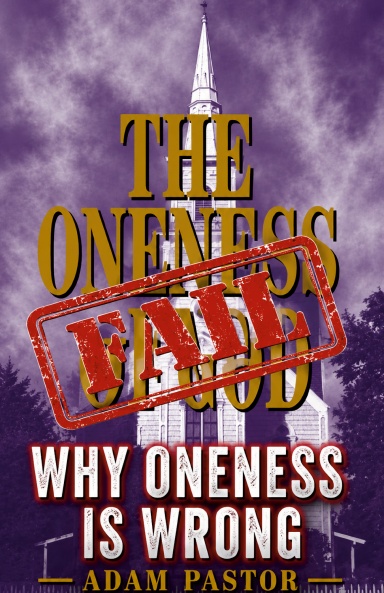
That question lies at the heart of my new book, Why Oneness Is Wrong.
For many Christians, particularly those within or familiar with Oneness Pentecostalism, the theological alternatives can appear remarkably narrow. Either Jesus is the one God—the Father Himself manifested in flesh—or one must embrace the traditional doctrine of the Trinity.
But are those really the only possibilities?
I believe the biblical evidence points to another conclusion: there is one God, the Father, and one uniquely appointed human Messiah, Jesus Christ.
The Question That Changed Everything
Oneness theology presents an initially simple proposition: there is one God, and Jesus is that one God manifested in flesh.
But that proposition creates a series of difficult questions when we begin reading the New Testament carefully.
Why does Jesus pray to God?
Why does Jesus distinguish his will from the Father's will?
Why does Jesus say that the Father knows something that the Son does not know?
Why does Jesus identify himself and his Father as two witnesses?
Why does Scripture repeatedly say that God raised Jesus from the dead?
Why does Jesus sit at God's right hand?
Why is Jesus called the mediator between God and humanity?
And perhaps most strikingly, why does the resurrected and glorified Jesus still speak of the Father as “my God”?
These are not peripheral questions. They concern the identities of God and Jesus themselves.
“The Only True God”
One of the foundational passages examined in the book is John 17:3.
Jesus is praying to his Father when he says:
“And this is life eternal, that they might know You the only true God, and Jesus Christ, whom You have sent.”
The statement contains a remarkably straightforward distinction.
Jesus identifies the Father as “the only true God.”
He then identifies himself as Jesus Christ, the one whom God sent.
This same pattern appears throughout the New Testament.
Paul writes:
“But to us there is but one God, the Father... and one Lord Jesus Christ...”
— 1 Corinthians 8:6
And elsewhere:
“For there is one God, and one mediator between God and humanity,
the man Christ Jesus.”
— 1 Timothy 2:5
These passages provided the foundation for what I call the One God One Human Messiah framework.
God and His Human Messiah
The argument of Why Oneness Is Wrong is not that Jesus is insignificant.
Far from it.
Jesus is God's uniquely begotten Son, His Messiah, His supreme agent, the risen Lord, the mediator between God and humanity, and the one whom God has appointed to rule His coming Kingdom.
But none of these truths requires Jesus to be the God who appointed him.
Peter's Pentecost sermon provides an extraordinary example.
He introduces Jesus as:
“Jesus of Nazareth, a man attested by God...”
and says that the miracles were works:
“which God did by him.”
Peter then declares that Jesus was killed, but:
“This Jesus has God raised up...”
Jesus is subsequently exalted to God's right hand.
And Peter's argument reaches its climax in Acts 2:36:
“God has made this Jesus, whom you have crucified, both Lord and Christ.”
Consider the significance of those words.
God made Jesus Lord.
Jesus's Lordship is real. His authority is extraordinary. His exaltation is unparalleled.
But there remains a distinction between the God who exalts and the Messiah whom God exalts.
What About the Famous Oneness Proof Texts?
Of course, Oneness theology does not rest upon one or two passages.
That is why Why Oneness Is Wrong directly examines many of the texts commonly presented as evidence that Jesus is Almighty God or that Jesus is the Father.
Among them are:
- John 1:1 — “the Word was God”
- John 8:58 — “Before Abraham was, I am”
- John 10:30 — “I and my Father are one”
- John 14:9 — “He who has seen me has seen the Father”
- John 20:28 — “My Lord and my God”
- Isaiah 9:6 — “The mighty God, The everlasting Father”
- Colossians 2:9 — “all the fullness of the Godhead bodily”
- 1 Timothy 3:16 — “God was manifest in the flesh”
- Hebrews 1:8 — “Your throne, O God”
- Revelation 1:8 — “the Alpha and Omega”
Rather than isolating these passages from their surroundings, the book asks what happens when they are read alongside the passages immediately before and after them—and within the larger biblical presentation of God and His Messiah.
The results are often very different from what a proof-text reading might suggest.
Two Witnesses: A Particular Problem for Oneness Theology
One passage deserves special attention.
In John 8:17–18, Jesus appeals to the biblical requirement for two witnesses.
He says:
“I am one who bears witness of myself, and the Father who sent me bears witness of me.”
Jesus's argument depends upon there being two witnesses:
Jesus himself
and
the Father who sent him.
If Jesus and the Father are actually the same individual, a serious question arises: Where are the two witnesses?
The distinction is not incidental to Jesus's argument. It is the argument.
This is one of many places where I believe the straightforward reading of Scripture creates considerable difficulty for the Oneness model.
“My God”: The Words of the Glorified Jesus
Revelation 3:12 raises another remarkable problem.
This is not Jesus during his earthly ministry.
This is the resurrected, exalted and glorified Jesus speaking from heaven.
And four times in a single verse he says:
“my God.”
That deserves to be allowed its full force.
Jesus had a God during his earthly ministry.
Jesus was raised by God.
Jesus was exalted by God.
And the glorified Jesus still speaks of “my God.”
If Jesus is himself the one Almighty God, what exactly does it mean for Almighty God to have a God?
The One God One Human Messiah framework does not need to explain this language away. It expects it.
Jesus is God's glorified Messiah.
A Non-Trinitarian Critique of Oneness
There is another important feature of this book.
Why Oneness Is Wrong is not a defence of the Trinity.
I am not arguing that Oneness theology is wrong because God is three persons.
Instead, I ask a more fundamental question:
Does the biblical evidence actually identify Jesus as the one God—the Father Himself—or does Scripture consistently distinguish the one God from the Messiah whom He sent?
This allows the Oneness position to be examined on its own merits rather than simply comparing one post-biblical theological system with another.
My argument is that the biblical pattern is considerably simpler:
One God — the Father.
One human Messiah — Jesus Christ.
God sends him.
God anoints him.
God works through him.
Jesus obeys God.
Jesus prays to God.
Jesus dies.
God raises him.
God exalts him.
God makes him Lord and Messiah.
And the exalted Jesus continues to call the Father “my God.”
Why the Humanity of Jesus Matters
The genuine humanity of Jesus is not something Christianity should be embarrassed about.
It is essential to the gospel.
Jesus is the second Adam who succeeds where the first Adam failed.
He is our human mediator.
He is our high priest.
He is the obedient Son.
He is the man through whom God will judge the world.
His obedience matters precisely because it is genuine human obedience.
His temptations matter because they are genuine.
His prayers matter because they are genuine.
His death matters because he genuinely dies.
And his resurrection is magnificent precisely because God raised His faithful Messiah from the dead.
Making Jesus genuinely human does not diminish him.
It allows us to appreciate the extraordinary position to which God has exalted him.
One God. One Human Messiah.
The central argument of Why Oneness Is Wrong can therefore be expressed quite simply.
The Bible does not present Jesus as a second God alongside the Father.
Neither, I argue, does it present Jesus as the Father Himself appearing under another manifestation.
It presents:
the one God
and
His human Messiah.
The Father is the God who sends.
Jesus is the Messiah who is sent.
The Father is the God who empowers.
Jesus is the man through whom God works.
The Father is the God who raises the dead.
Jesus is the Messiah whom He raised.
The Father is the God who grants authority.
Jesus is the Lord to whom that authority has been given.
Distinction without rivalry.
Unity without identity.
Authority without equality of source.
And above all:
One God and His uniquely appointed human Messiah.
About Why Oneness Is Wrong
Why Oneness Is Wrong is a detailed biblical examination of Oneness theology written from a non-Trinitarian perspective.
Across its chapters, the book examines the biblical identity of God and Jesus, the Law of Agency, the two witnesses of John 8, Psalm 110:1, Gethsemane, Jesus's humanity, his priesthood and mediation, his resurrection and exaltation, the Book of Revelation, and numerous passages frequently presented as proof that Jesus is Almighty God.
It also examines textual and translation questions surrounding passages such as:
1 Timothy 3:16, Titus 2:13, Hebrews 1:8 and Isaiah 9:6.
The purpose is not merely to dismantle a theological position.
It is to recover what I believe to be the beautifully simple apostolic confession:
“For there is one God, and one mediator between God and humanity,
the man Christ Jesus.”
— 1 Timothy 2:5
Why Oneness Is Wrong
by Adam Pastor
The book is available now from Lulu:
One God. One Human Messiah.


