Shalom! My name is Adam Pastor

Welcome to ADONI MESSIAH which means
"My Lord Messiah" -
a fitting epithet to who Jesus (or Yeshua) is!

Here, I attempt to present the Apostolic Truths according to the Scriptures, that there is
One GOD, the Father, namely, YAHWEH,
and One Lord, GOD's only begotten Son,
Yeshua the Messiah.

And that one day YAHWEH will send His Son back to Earth to inaugurate the Everlasting Kingdom of GOD


Enjoy!


Monday, December 18, 2006

My answer to 7 Assertions

A couple of years ago on another forum, someone who believed in the so-called 'deity of Christ' presented the following assertions. Here are my replies to each assertion ...

Assertion 1:
Jesus Accepted Worship Jesus Himself told Satan that no one should be worshipped and served except God (Matthew 4:10 and Luke 4:8 . Yet… Jesus accepted worship.


MY REPLY:
Jesus was and is 'worshipped' because he is the Lord Messiah, the Son of the Living GOD. The scriptures distinctly depict two types of appropriate worship
1) The worship which belongs to GOD Almighty alone
2) And the worship which is given to kings, prophets and dignitaries.
For example, (1 Chr 29:20) And David said to all the congregation, Now bless YAHWEH your God. And all the congregation blessed YAHWEH God of their fathers, and bowed down their heads, and worshipped YAHWEH, and the king.


The Bible's words for worship, are the Hebrew word Shachah and the Greek word Proskuneo.
They are consistently used in regards to both GOD and men. 
I have already gone into greater detail, therefore I refer you to:
The Worship of Christ

Assertion 2:
Jesus Demonstrated That He was God

Jesus had authority over demons and Jesus said His miracles spoke for him (John 10:25). The Old Testament prophesied of Jesus. Jesus also said that no one came to the Father except through Him (John 14:6; 6:45; 8:24) ... Jesus made Himself equal with God


MY REPLY:
Both the authority that Jesus exhibited and the miracles proved the point that Jesus was indeed the Messiah, GOD's agent, GOD's representative, GOD's Anointed One, GOD's Sent One. Therefore, Jesus solely claimed to be the Messiah. He never ever made himself equal to Almighty GOD. All the examples that you used can be explained in that light.
Jesus is GOD's ultimate plenipotentiary and representative.

Assertion 3:
Jesus said for us to "believe also in Me." In John 14:1b. Do you believe in Jesus?

MY REPLY:
Seeing that Jesus is 'THAT PROPHET' spoken of by Moses who was to be 'like unto Moses' [Deut 18:15,18-19],
I personally, do indeed believe in him.
Compare ...

  • (John 14:1) Let not your heart be troubled: ye believe in God, believe also in me.
  • (Exo 14:31) And Israel saw that great work which YAHWEH did upon the Egyptians: and the people feared YAHWEH, and believed YAHWEH, and his servant Moses.
  • (1 Sam 12:18 ) So Samuel called unto YAHWEH; and YAHWEH sent thunder and rain that day: and all the people greatly feared YAHWEH and Samuel.

Assertion 4:
Jesus Forgave Sins Against God
Only God can forgive sins, and Jesus forgave sins against God, then Jesus was showing that He was God.

MY REPLY:
If that indeed proved that Jesus was Almighty GOD, then all the apostles are GOD also!  What do I mean?
The same authority wherewith Jesus forgave sins was given to his apostles.
(John 20:20-23) And when he had so said, he showed unto them his hands and his side. Then were the disciples glad, when they saw the Lord. 21 Then said Jesus to them again, Peace be unto you: as my Father hath sent me, even so send I you. 22 And when he had said this, he breathed on them, and saith unto them, Receive ye the Holy Ghost: 23 Whose soever sins ye remit, they are remitted unto them; and whose soever sins ye retain, they are retained.

The words 'forgiven/forgive' in Matt chap. 9 and the words 'remit/remitted' in John chap. 20 are the same Greek word aphiemi ...
John 20:23 could easily read ... Whose soever sins ye forgive, they are forgiven unto them; ...

The apostles were to forgive/remit sins even as Jesus their Master had done so!!
Yet they are not GOD are they???

Let's look again at this event ...
[Please note: The word used for 'power' is the Greek word exousia which means AUTHORITY!]

Quote:
(Mat 9:4-8 ) And Jesus knowing their thoughts said, Wherefore think ye evil in your hearts? 5 For whether is easier, to say, Thy sins be forgiven thee; or to say, Arise, and walk? 6 But that ye may know that the Son of man hath power/AUTHORITY on earth to forgive sins, (then saith he to the sick of the palsy,) Arise, take up thy bed, and go unto thine house. 7 And he arose, and departed to his house. 8 But when the multitude saw it, they marvelled, and glorified God, which had given such power/AUTHORITY unto men.
(Mark 2:12) And immediately he arose, took up the bed, and went forth before them all; insomuch that they were all amazed, and glorified God, saying, We never saw it on this fashion.
(Luke 5:25-26) And immediately he rose up before them, and took up that whereon he lay, and departed to his own house, glorifying God. 26 And they were all amazed, and they glorified God, and were filled with fear, saying, We have seen strange things to day.


Get it! The man's sins were forgiven via the authority that Almighty GOD had given to Jesus, the Son of man ... in light of this, the witnesses of this great event glorified GOD who gave such authority to men.

Thank GOD for common people! [Mark 12:37] Who are not bound up by Greek Hellenistic philosophy and church councils' teachings ... common people ... who could clearly see that this man before them, the man Jesus of Nazareth [Acts 2:22] was not GOD Almighty but rather GOD's authorized, appointed agent ... a man authorized and appointed to forgive sins on behalf of GOD Himself ... a man who did all things by the power of GOD, because it was GOD the Father who did the works!


Whose report will we believe? Those who believed on him [Matt 9:8, Acts 2:22]
or the so-called church fathers who taught that Jesus is Almighty GOD?
The choice is ours!!

Assertion 5:
Jesus did one of two things: a) Showed He was God by proving He had the power, b) Deliberately misled them to believe that He was God when He was not.

MY REPLY:
Jesus did NEITHER.

What he did  or rather what GOD did through him,
was to show that His Son was authorized and appointed by Him to forgive sins and heal in His name.
As Jesus himself said ....

  • (John 5:19) Then answered Jesus and said unto them, Verily, verily, I say unto you, The Son can do nothing of himself, but what he seeth the Father do: for what things soever he doeth, these also doeth the Son likewise.
  • (John 8:28 ) Then said Jesus unto them, When ye have lifted up the Son of man, then shall ye know that I am he, and that I do nothing of myself; but as my Father hath taught me, I speak these things.
  • (John 14:10-11) Believest thou not that I am in the Father, and the Father in me? the words that I speak unto you I speak not of myself: but the Father that dwelleth in me, he doeth the works. 11 Believe me that I am in the Father, and the Father in me: or else believe me for the very works' sake.

Jesus had NO POWER OF HIMSELF. GOD worked through Jesus. GOD the Father did all the works. Jesus DID NOTHING OF HIMSELF.
GOD via the works showed that Jesus was the Messiah and His Son.

Jesus misled no one. He taught those who had an ear to hear, that he was indeed, the Messiah, the Son of the Living GOD, and as such, they were to put their trust in him, because everything he said and did, was OF GOD ALMIGHTY, his Father and not of himself!

Quote:
(John 12:48-50) He that rejecteth me, and receiveth not my words, hath one that judgeth him: the word that I have spoken, the same shall judge him in the last day. 49 For I have not spoken of myself; but the Father which sent me, he gave me a commandment, what I should say, and what I should speak. 50 And I know that his commandment is life everlasting: whatsoever I speak therefore, even as the Father said unto me, so I speak.


Assertion 6:
However, note that Jesus said "But that you may know that the Son of Man has power on earth to forgive sins". So Jesus said it was He who had the power, and he was not just announcing that the Father forgave.


MY REPLY:
Jesus 'HAD' authority/power to forgive sins because it was GIVEN him from Almighty GOD.
[Please note: The word used for 'power' is the Greek word exousia which means AUTHORITY!]

Quote:
(Mat 9:4-8 ) And Jesus knowing their thoughts said, Wherefore think ye evil in your hearts? 5 For whether is easier, to say, Thy sins be forgiven thee; or to say, Arise, and walk? 6 But that ye may know that the Son of man hath power/AUTHORITY on earth to forgive sins, (then saith he to the sick of the palsy,) Arise, take up thy bed, and go unto thine house. 7 And he arose, and departed to his house. 8 But when the multitude saw it, they marvelled, and glorified God, which had given such power/AUTHORITY unto men.


Assertion 7:
The Rest of the New Testament

The gospels and the rest of the New Testament shows that Jesus' followers were taught that Jesus was God.

a) Jesus and the Father have the same nature (Philippians 2:5)

b) Both are rightfully worshipped (Hebrews 1:6)

c) Both rightfully called God (John 1:1; Heb 1:8,9)

d) Both are prayed to (Acts 7:7:59-60)

e) Everything in the world was created through Christ (John 1:3, 10, Colossians 1:16)

f) Everything is sustained through Christ (Col 1:17)

g) The fullness of deity is in Jesus (Colossians 1:19).

h) Jesus is called God in 2 Cor. 11:3 and Titus 2:13

i) Worshipped in Heaven in Revelation 5:8-9; 22:20

j) Prayed to Christ Acts 7:59


MY REPLY:
Rather, the gospels and the rest of the New Testament shows that Jesus' followers were taught ...
that Jesus was indeed the Messiah, the Son of the Living GOD, GOD's appointed agent and plenipotentiary

  1. The Greek text of Philippians 2:6 is more correctly rendered that Jesus did not grasp after equality with GOD
    Unlike Adam [Gen 3:5]. Where Adam failed, Jesus succeeded. Where Adam sought to exalt himself, Jesus humbled himself.
    As followers of Christ, we ought to have the same mind.
    The expression 'form of GOD' is equivalent to 'image of GOD' [Gen 1:27]; i.e. Jesus the second man, the second Adam, being a man, he was indeed the ultimate 'image of GOD', the ultimate 'man'; he was the image that GOD had intended all men to be ... Jesus proved this by being in total submission to Almighty GOD, hence all his followers now need to be conformed to Jesus' image. [Rom 8:29]
  2. Both are rightfully worshipped (Hebrews 1:6)
    Yes. GOD as GOD ALMIGHTY! Jesus as the King Messiah, the man whom Almighty GOD made both Christ and Lord of all; even angels therefore, have been made subject to him. [Acts 2:36, 10:36; 1 Pet 3:22, 1 Cor 15:27-28; Heb 2:5-9]
  3. John 1:1 is speaking about the word of God
    Moses is also called 'God/elohim'. [Exo 7:1] So were the OT judges [Exo 21:6, 22:8-9] So your point is?
  4. Stephen is speaking to Jesus who he sees.
    Stephen is not praying to him. He is invoking and calling upon Jesus whilst beholding him. There is a difference!.

    Solely GOD the Father is prayed to throughout the scriptures, both OT & NT.
  5. Everything in the world was created by GOD Almighty.
    The new creation, the new heavens and earth are created by GOD through Christ.
    John 1:3 is about GOD's spoken word (cp. Psalms 33:6,9)

    John 1:10 is talking about Jesus, the Son of the Creator.
    The Scriptures recognized solely ONE Creator ... this ONE Creator is YAHWEH, the GOD of Abraham, Isaac & Jacob;
    the GOD & Father of our Lord Jesus Christ. [Mal 2:10]; YAHWEH created all things alone! [Isa 44:24]
    What the biased KJV translators did was to translate the Greek word ’dia’ as ‘by’ in v.10. They did the same thing in Col 1:16, Eph 3:9, and Heb 1:2; hence to foist their doctrine/leaven that a ‘God the Son’ made all things. However this is not what the Scriptures teach.

    The Greek word ’dia’ around 88 times is translated ‘through’.
    Hence, John 1:10 need not to be translated ‘by’ but rather THROUGH! Therefore, GOD Almighty, the Father, made all things with His Son in mind ... with His Son in view. (In like manner, Col 1.16 is about the new creation to come. GOD also is creating this new creation with His Son in view!)

    So, concerning John 1.10 ... Hence the Son was in the world, and the world was made actually by GOD the Father THROUGH the Son [i.e. in view of the Son], and the world knew the Son not.
    This verse is definitely NOT saying that Jesus the Messiah made all things!
     
    The Scriptures teach no such thing. Both Christ [Mark 10:6, 13:19] and the apostles [Acts 4:24, 14:15, 17:24 cp. Matt 11:25, Luke 10:24] taught that GOD, the Father, namely YAHWEH; is the sole Creator of all things. In fact, in NO Jewish writings (I am open to be corrected) will you find any concept that the Messiah is the Creator or Maker of all things. In fact, let me quote from the Talmud that also gives the gist of what I am saying ...

    Babylonian Talmud, Sanhedrin 98b wrote:
    ”The World was not Created but only for the Messiah

  6. Everything is sustained through Christ (Col 1:17)
    Yep! That is his appointed position by Almighty GOD. However, it is GOD who sustains all things through Christ.
  7. Yep! GOD's fullness dwells in the man Christ Jesus.
    He may be 'full of GOD' however he is not GOD. Rather, Jesus is GOD's human temple.
    Also, Paul prayed that ... (Eph 3:19) And to know the love of Christ, which passeth knowledge, that ye might be filled with all the fulness of God.
  8. Jesus is called God in 2 Cor. 11:3 and Titus 2:13
    He is???

    (2 Cor 11:3) But I fear, lest by any means, as the serpent beguiled Eve through his subtlety, so your minds should be corrupted from the simplicity that is in Christ.
    Bit puzzled by this one.

    However, the Greek text of Titus 2:13 reads rather:
    (Titus 2:13) Looking for that blessed hope, and the appearing of the glory of the great God AND our Saviour Jesus Christ;
    Compare (Mat 16:27) For the Son of man shall come in the glory of his Father with his angels; and then he shall reward every man according to his works.
    (Luke 9:26) For whosoever shall be ashamed of me and of my words, of him shall the Son of man be ashamed, when he shall come in his own glory, and in his Father's, and of the holy angels.
    See also Mark 8:38
  9. Revelation 5:8-9 ... Yep! Christ is due worship and honor as the Lamb of Almighty GOD.
    (Rev 5:9) And they sung a new song, saying, Thou art worthy to take the book, and to open the seals thereof: for thou wast slain, and hast redeemed us to God by thy blood out of every kindred, and tongue, and people, and nation;
  10. Check any bible. The word 'God' in Acts 7:59 is in italics i.e. it is NOT in the Greek text
    Acts 7:59 actually reads ... And they stoned Stephen, calling upon and saying, Lord Jesus, receive my spirit.

 

Sunday, December 17, 2006

The Worship of Christ

A couple of years ago, I was asked about the 'worship' of Christ on another forum. This was my reply ...

Greetings ...,
allow me to elaborate on 'worship' and its distinctions.

Theologians call it, 'religious worship' (which is due to GOD alone)
and 'civil worship' (which is due to men such as dignitaries and kings).
The Scriptures describe both kinds of 'worship'.

The Hebrew word for worship, shachah - Strong's 7812, is used more often in the OT (the Hebrew Bible), in regards to men, than it is used in regards to Almighty GOD!! The KJV/Bible translators obscured this fact by translating this word as
bow down, fall down, make obeisance, do obeisance, do reverence, etc.
However, the main thing to notice, is that this kind of 'worship' does not violate the commandments which speak of the worship which is due to Almighty GOD alone. Why? Because when men are shachah-worshipped in the OT, they are not being worshipped AS Almighty GOD! They are shachah-worshipped for who they are and for what (or who) they represent. Hence men of GOD, patriarchs, prophets and kings, (even parents and siblings), were given due worship/reverence accordingly ... it is obvious, however, that these men were not being shachah-worshipped AS Almighty GOD!

The kings of Israel/Judah of the OT, were the anointed ones of GOD, GOD's appointed kings; they were royalty, they were therefore, given due worship/obeisance. This 'kind of (civil) worship' is still witnessed today in countries which still have royal families. From what I gathered, the English call it 'curtsy'; and they also refer to their 'mayor' as 'the Right Worshipful'!
In contrast, in biblical times, it was the norm to fall flat on one's face, when greeting a dignitary or king.

The NT equivalent word for worship is proskuneo - Strong's 4352. When Jesus gave the parable about forgiveness concerning a certain king [Matt 18:23], he described how the servant proskuneo-worshipped the king [v. 26]; whilst in contrast, the servant's fellowservant simply besought him! [v. 29] The difference being, the servant was no king! Even in the regeneration when the saints are glorified, the enemies of the saints will have to proskuneo-worship before their feet. [Rev 3:9] The implications should be clear!

The OT, therefore, gives us the necessary backdrop of the NT. When we search the Scriptures (as commanded by our Master Rabbi/Teacher Jesus), we can now see why Jesus of Nazareth was proskuneo-worshipped. Just like the patriarchs, prophets, dignitaries and kings of old, Jesus of Nazareth was given due worship/reverence.
Why? Because Jesus of Nazareth is

  • the promised Prophet par excellence of Deut 18:15,18-19;
  • the promised King of Psalms 2; the promised
    'Son of GOD/David'
    of 2 Sam 7:14, 1 Chron. 17:11-14;
  • the promised David's lord of Psalms 110:1.
When recognized as such, he was given due worship/obeisance/shachah/proskuneo as shown throughout the NT.

Some recognized Jesus as the promised 'Son of GOD/David', the King of Israel, the Messiah.
Please note: these terms are synonymous. 'Son of GOD' is equivalent to King of Israel. In biblical times, to claim to be the Son of GOD was to claim to be the King of Israel, the King of the Jews. Hence Nathaniel's statement: (John 1:49) Nathanael answered and saith unto him, Rabbi, thou art the Son of God; thou art the King of Israel.
Solomon was the first king to be conferred the title Son of GOD or GOD's Son (See 1 Chron 22:6-11, 28:5-7).
Son of GOD, therefore, is actually a royal title! - Let me use a quote from Colin Brown,

Colin Brown wrote:
the title "Son of God" is not in itself a designation of personal deity or an expression of metaphysical distinctions within the Godhead. Indeed to be "Son of God" one has to be a being who is not God! It is a designation for a creature indicating a special relationship with God. In particular, it denotes God’s representative, God’s vice-regent. It is a designation of kingship, identifying the king as God’s son.

Being recognized as 'the Son of GOD',
Jesus was proskuneo-worshipped as such
e.g. Matt 14:33, John 9:35-38, etc.
Whilst others, simply recognized him as a mighty Prophet of GOD, and proskuneo-worshipped him as such
e.g. Matt 8:2, 9:18, etc.
(Even the Romans mockingly proskuneo-worshipped him as the 'King of the Jews' - Mark 15:18-19)

By searching the OT, we see that the NT examples are nothing out of the ordinary. The difference being that Jesus of Nazareth is 'the Promised One, the Promised Messiah, the Promised King'.
The Magi from the east came from afar, therefore, to give due worship/reverence and pay homage to the Promised King of Israel hence the Magi's request (Matthew 2:2) Saying, Where is he that is born King of the Jews? for we have seen his star in the east, and are come to worship him; and Herod's reply (Matthew 2:8) And he sent them to Bethlehem, and said, Go and search diligently for the young child; and when ye have found him, bring me word again, that I may come and worship him also.

The Magi never came to worship a deity or a 'god-man'. NO! They came to pay homage and give due reverence/worship [Matt 2:11] to GOD's Son, GOD's Anointed One, GOD's Chosen King.
(compare in contrast, Matt 21:37-39, Mark 12:6-8, Luke 20:13-15)

Throughout the NT we see other examples of this reverence. Jesus died because he proclaimed that he was the Messiah, the King of Israel, the promised Son of GOD of Psalms 2. However, to quote

Colin Brown wrote:
The designation of Jesus as "Son of God in power according to the Spirit of holiness by his resurrection from the dead" (Rom. 1:4) is a reaffirmation of that Son-Kingship with divine authority, insofar as by the resurrection the Spirit has overturned the negative verdict of the Sanhedrin in condemning Jesus to death as a blasphemer who sought to lead Israel astray.


Like I said earlier, the OT gives us the necessary backdrop for the NT. So here are some more examples of this kind of worship (The word(s) which correspond to shachah are in red) :-
  • (Genesis 23:7) And Abraham stood up, and bowed himself to the people of the land, even to the children of Heth.
  • (Genesis 23:12) And Abraham bowed down himself before the people of the land.
  • {towards Esau} (Genesis 33:3) And he passed over before them, and bowed himself to the ground seven times, until he came near to his brother.
  • (Genesis 33:6-7) Then the handmaidens came near, they and their children, and they bowed themselves. 7 And Leah also with her children came near, and bowed themselves: and after came Joseph near and Rachel, and they bowed themselves.
  • {towards Joseph} (Genesis 42:6) And Joseph was the governor over the land, and he it was that sold to all the people of the land: and Joseph's brethren came, and bowed down themselves before him with their faces to the earth.
  • (Genesis 43:26) And when Joseph came home, they brought him the present which was in their hand into the house, and bowed themselves to him to the earth.
  • (Genesis 43:28 ) And they answered, Thy servant our father is in good health, he is yet alive. And they bowed down their heads, and made obeisance.
  • {towards Moses} (Exodus 11:8 ) And all these thy servants shall come down unto me, and bow down themselves unto me, saying, Get thee out, and all the people that follow thee: and after that I will go out. And he went out from Pharaoh in a great anger.
  • {towards Jethro} (Exodus 18:7) And Moses went out to meet his father in law, and did obeisance, and kissed him; ...
  • (1 Samuel 24:8 ) David also arose afterward, and went out of the cave, and cried after Saul, saying, My lord the king. And when Saul looked behind him, David stooped with his face to the earth, and bowed himself.
  • {towards David} (1 Samuel 25:41) And she arose, and bowed herself on her face to the earth, and said, Behold, let thine handmaid be a servant to wash the feet of the servants of my lord.
  • (2 Samuel 9:6) Now when Mephibosheth, the son of Jonathan, the son of Saul, was come unto David, he fell on his face, and did reverence. And David said, Mephibosheth. And he answered, Behold thy servant!
  • (2 Samuel 9:8 ) And he bowed himself, and said, What is thy servant, that thou shouldest look upon such a dead dog as I am?
  • (2 Samuel 14:4) And when the woman of Tekoah spake to the king, she fell on her face to the ground, and did obeisance, and said, Help, O king.
  • (2 Samuel 14:22) And Joab fell to the ground on his face, and bowed himself, and thanked the king: ...
  • (2 Samuel 14:33) So Joab came to the king, and told him: and when he had called for Absalom, he came to the king, and bowed himself on his face to the ground before the king: and the king kissed Absalom.
  • {towards Absalom} (2 Samuel 15:5) And it was so, that when any man came nigh to him to do him obeisance, he put forth his hand, and took him, and kissed him.
  • {towards King David} (2 Samuel 18:28 ) And Ahimaaz called, and said unto the king, All is well. And he fell down to the earth upon his face before the king, and said, Blessed be YAHWEH thy God, which hath delivered up the men that lifted up their hand against my lord the king.
  • (2 Samuel 24:20) And Araunah looked, and saw the king and his servants coming on toward him: and Araunah went out, and bowed himself before the king on his face upon the ground.
  • (1 Kings 1:16) And Bathsheba bowed, and did obeisance unto the king. And the king said, What wouldest thou?
  • (1 Kings 1:23) And they told the king, saying, Behold Nathan the prophet. And when he was come in before the king, he bowed himself before the king with his face to the ground.
  • (1 Kings 1:31) Then Bathsheba bowed with her face to the earth, and did reverence to the king, and said, Let my lord king David live for ever.
  • (1 Kings 1:53) So king Solomon sent, and they brought him down from the altar. And he came and bowed himself to king Solomon: and Solomon said unto him, Go to thine house.
  • (1 Kings 2:19) Bathsheba therefore went unto king Solomon, to speak unto him for Adonijah. And the king rose up to meet her, and bowed himself unto her, and sat down on his throne, and caused a seat to be set for the king's mother; and she sat on his right hand.
  • {towards Elisha} (2 Kings 2:15) And when the sons of the prophets which were to view at Jericho saw him, they said, The spirit of Elijah doth rest on Elisha. And they came to meet him, and bowed themselves to the ground before him.
  • (2 Kings 4:37) Then she went in, and fell at his feet, and bowed herself to the ground, and took up her son, and went out.
  • (1 Chronicles 21:21) And as David came to Ornan, Ornan looked and saw David, and went out of the threshingfloor, and bowed himself to David with his face to the ground.

And the list goes on ...

Therefore in conclusion, let us remember, there is 'worship' which is due unto solely Almighty GOD [e.g. Exo 20:5, Deut 5:19,
Matt 4:10, John 4:20-24, Rev 4:10-11, 19:10, 22:9, etc] and there is 'worship' which is due unto the King Messiah
[e.g. Matt 14:33, 20:20, 28:9, etc].
Compare the worship/shachah of YAHWEH & King David i.e.
(1 Chronicles 29:20) And David said to all the congregation, Now bless YAHWEH your God. And all the congregation blessed YAHWEH God of their fathers, and bowed down their heads, and worshipped YAHWEH, and the king.
...

Thursday, November 23, 2006

Concerning Rev 3.21

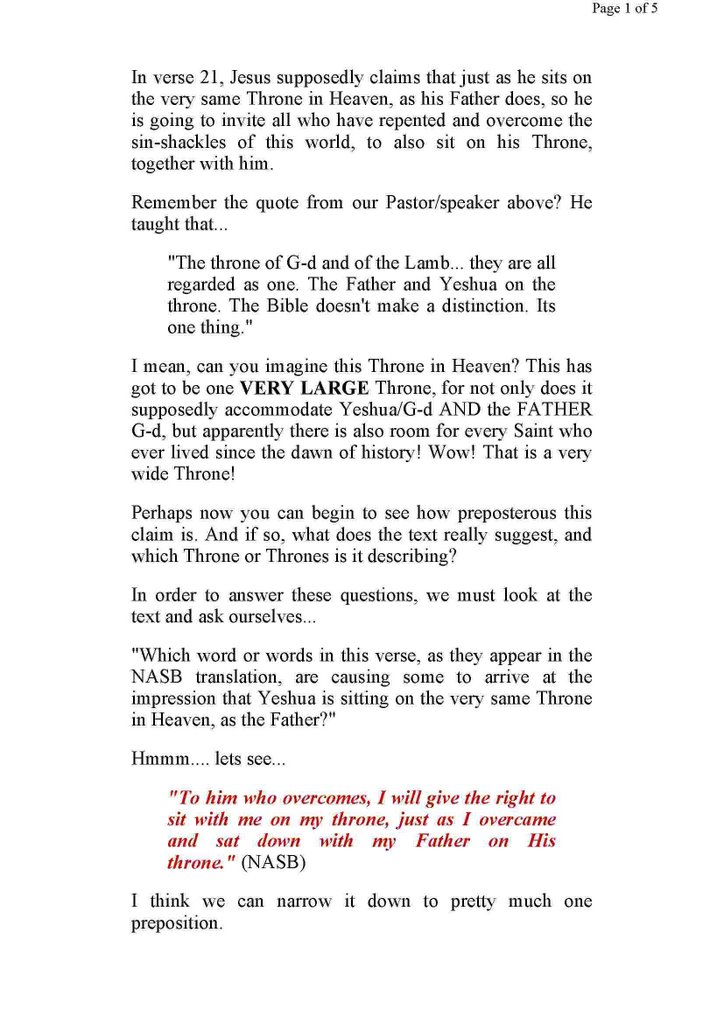
Here is an extract of an article about Rev 3:21 from a Messianic Jewish site, that I read some years back. The writer after reading a typical trinitarian exposition of Rev 3.21; refutes the trinitarian viewpoint accordingly. Here is the writer's refutation, as follows: The 5 pages are placed here as 5 images. Click each image to enlarge.

Sunday, November 19, 2006

The LORD and the Lord

The LORD and the Lord

The LORD fills the pages of the Old Testament. The Old Testament has over 6000 references to the LORD. The LORD is revealed to be the Creator, the God of Abraham, Isaac, and Jacob, the God of our fathers, the God of Israel.
In short, the LORD is the God of the Old Testament.

The Lord Jesus fills the pages of the New Testament. He is revealed to be "that prophet," the Messiah, the son of God, the one who died and was raised again. Jesus is the Lord of the New Testament.

Is the LORD of the Old Testament the same Being as the Lord of the New Testament? That is to say,
was the LORD in the Old Testament the one who became the Lord Jesus in the New Testament?
Is the LORD = the Lord? Are they one and the same Being? What does the evidence from the Bible say?

In order to identify those involved in our study, it is most helpful to call them by their names. In our English language Bibles, we read the name of God as "the LORD." This is, of course, not a name, but rather a title. The phrase "the LORD" is a substitution for the Hebrew name YHWH. YHWH is thought by some to be pronounced Yahweh, and by others to be Jehovah. Pronunciation aside (there is one right way to pronounce the name, but none of us are certain what it is), it is of great value to recognize that YHWH is his name—not to obtain salvation through pronunciation, but rather to properly identify who we are talking about. (I will use YaHWeH.) YaHWeH identified himself by revealing his name to us, in the Hebrew language:

  • And God said moreover unto Moses, Thus shalt thou say unto the children of Israel, YaHWeH God of your fathers, the God of Abraham, the God of Isaac, and the God of Jacob, hath sent me unto you: this is my name for ever, and this is my memorial unto all generations. Exodus 3:15
  • I am YaHWeH: that is my name: and my glory will I not give to another, neither my praise to graven images.
    Isaiah 42:8

Notice that in these verses, and thousands and thousands more like them, singular pronouns (I, me, my, mine) are used in connection with YaHWeH, the God of the Old Testament. YaHWeH is a single person, not a family. If the name YaHWeH referred to a family, the pronouns used would be plural (we, us, our, ours). The overwhelming number of pronouns used that refer to YaHWeH God are singular.

In our English language Bibles, the name of the Lord Messiah is rendered "Jesus." But the name that he called himself, and the name that family, friends, and foes called him was his Hebrew given name: Yeshua. This name is the same name as the leader who succeeded Moses, commonly (although erroneously) called Joshua. The name Yeshua means ‘Yahweh saves’—a perfect description of the life mission of our Lord Yeshua the Messiah. Just as "Joshua" led the children of Israel into the promised land, Messiah Yeshua will lead the children of God into the promised land of the coming Kingdom of God.

The LORD (YaHWeH) and the Lord (Yeshua) have different names

The LORD, the God of the Old Testament, is named YaHWeH, whereas the Lord Messiah is named Yeshua. These two personages are frequently addressed as distinct individuals in the salutations of Paul’s letters:

  • Paul, an apostle, (not of men, neither by man, but by Jesus Christ, and God the Father, who raised him from the dead;) Galatians 1:1
  • Grace be unto you, and peace, from God our Father, and from the Lord Jesus Christ. Philippians 1:2
  • Grace unto you, and peace, from God our Father and the Lord Jesus Christ. II Thessalonians 1:2
  • Unto Timothy, my own son in the faith: Grace, mercy, and peace, from God our Father and Jesus Christ our Lord. I Timothy 1:2

Therefore, Is the LORD = the Lord? Why then do they have different names?

The LORD (YaHWeH) prophesied the birth of the Lord Yeshua

  • And YaHWeH God said unto the serpent, Because thou hast done this, thou art cursed above all cattle, and above every beast of the field; upon thy belly shalt thou go, and dust shalt thou eat all the days of thy life: And I will put enmity between thee and the woman, and between thy seed and her seed; it shall bruise thy head, and thou shalt bruise his heel. Genesis 3:14-15

We know that the Lord Jesus is the seed of the woman. Later In Isaiah, YaHWeH prophesies the birth of the Lord Jesus:

  • Ask thee a sign of YaHWeH thy God; ask it either in the depth, or in the height above. But Ahaz said, I will not ask, neither will I tempt YaHWeH. And he said, Hear ye now, O house of David; Is it a small thing for you to weary men, but will ye weary my God also? Therefore the Lord himself shall give you a sign; Behold, a virgin shall conceive, and bear a son, and shall call his name Immanuel. Isaiah 7:11-14

Therefore, Is the LORD = the Lord? Did Jesus prophesy his own birth?

Mary praised The LORD (YaHWeH) while she was pregnant with the Lord Yeshua

  • And Mary said, My soul doth magnify the Lord [YaHWeH], And my spirit hath rejoiced in God my Saviour. For he hath regarded the low estate of his handmaiden: for, behold, from henceforth all generations shall call me blessed. For he that is mighty hath done to me great things; and holy is his name. And his mercy is on them that fear him from generation to generation. He hath shewed strength with his arm; he hath scattered the proud in the imagination of their hearts. He hath put down the mighty from their seats, and exalted them of low degree. He hath filled the hungry with good things; and the rich he hath sent empty away. He hath holpen his servant Israel, in remembrance of his mercy; As he spake to our fathers, to Abraham, and to his seed for ever. Luke 1:46-55

Mary was a faithful Israelite who worshipped YaHWeH, the God of her fathers. She knew of no other God. At the time that she spoke this prayer of praise, the Lord Yeshua was in her womb. She could ONLY have been speaking to and about God the Father, unless we are willing to entertain the notion that she was praying to the baby in her womb as her God. The God that Mary spoke to was the LORD (YaHWeH) God that she had known all her life. He was the God who spoke to her fathers, the God who spoke to Abraham. That God was most assuredly YaHWeH, the God of the Old Testament.

Therefore, Is the LORD = the Lord? Did Mary pray to the baby in her womb, calling him God?

The LORD (YaHWeH) declared that the Lord Jesus (Yeshua) was his son

  • The kings of the earth set themselves, and the rulers take counsel together, against YaHWeH, and against his anointed, saying, Let us break their bands asunder, and cast away their cords from us. He that sitteth in the heavens shall laugh: the Lord (Adonai) shall have them in derision. Then shall he speak unto them in his wrath, and vex them in his sore displeasure. Yet have I set my king upon my holy hill of Zion. I will declare the decree: YaHWeH hath said unto me, Thou art my Son; this day have I begotten thee. Psalms 2:2-7

In this famous messianic prophecy, YaHWeH God proclaimed that His anointed (chosen) one was His son. We know that the second Psalm is about the Lord Yeshua, whom the LORD (YaHWeH) affirms to be His son.

Therefore, Is the LORD = the Lord? Did Jesus declare that he was going to have a son?

The LORD (YaHWeH) anointed the Lord Jesus (Yeshua) to preach

In John 20:17 Yeshua of Nazareth said: "Touch me not; for I am not yet ascended to my Father: but go to my brethren, and say unto them, I ascend unto my Father, and your Father; and to my God, and your God." Yeshua is identifying his Father, his God, as the same one who is our Father, our God—the one known throughout the Old Testament as YaHWeH. When Yeshua entered into the synagogue on the Sabbath day and stood up to read, he read the following passage, explaining that he was the "me" of the passage:

  • The Spirit of the Lord YaHWeH is upon me; because YaHWeH hath anointed me to preach good tidings unto the meek; he hath sent me to bind up the brokenhearted, to proclaim liberty to the captives, and the opening of the prison to them that are bound; To proclaim the acceptable year of YaHWeH, and the day of vengeance of our God; to comfort all that mourn; Isaiah 61:1-2

Yeshua read in the scroll about YaHWeH, the God of the Old Testament. There is no indication that Yeshua himself had been that YaHWeH God, and that he was reading about…himself! Indeed, the passage expressly states that YaHWeH anointed Yeshua to preach good tidings. Did Yeshua anoint himself? The text indicates that Yeshua is a distinct person from YaHWeH.

Therefore, Is the LORD = the Lord? Did Yeshua anoint himself?

The LORD (YaHWeH) prophesied that the Lord Jesus would be a prophet

  • YaHWeH thy God will raise up unto thee a Prophet from the midst of thee, of thy brethren, like unto me [Moses]; unto him ye shall hearken; Deuteronomy 18:15

In the book of Acts, Peter bears witness to the fulfillment of this prophecy:

  • For Moses truly said unto the fathers, A prophet shall the Lord your God raise up unto you of your brethren, like unto me; him shall ye hear in all things whatsoever he shall say unto you.
  • Unto you first God, having raised up his servant Jesus, sent him to bless you, in turning away every one of you from his iniquities. Acts 3:22, 26

The LORD (YaHWeH) of the Old Testament fulfilled His prophecy to raise up a prophet unto Israel. That prophet was the Lord Jesus. Did he raise up himself?

Therefore, Is the LORD = the Lord? Did Jesus prophesy his own coming?

The LORD (YaHWeH) gave the Torah that the Lord Jesus (Yeshua) quoted to satan the devil

  • Then saith Yeshua unto him, Get thee hence, Satan: for it is written, Thou shalt worship the Lord thy God, and him only shalt thou serve. Matthew 4:10

This is a quote from the Torah:

  • Thou shalt fear YaHWeH thy God, and serve him, and shalt swear by his name. Deuteronomy 6:13

Yeshua affirmed that it was YaHWeH who gave the Torah to the children of Israel. Yeshua served only his God YaHWeH, and taught that we should do the same.

Therefore, Is the LORD = the Lord? Did Jesus quote the Torah that he had himself written? Was Yeshua the YaHWeH God of the Old Testament? Did he serve himself?

The LORD (YaHWeH) promised that the Lord (Yeshua) would be king upon the throne of David

  • Of the increase of his government and peace there shall be no end, upon the throne of David, and upon his kingdom, to order it, and to establish it with judgment and with justice from henceforth even for ever. The zeal of YaHWeH of hosts will perform this. Isaiah 9:7

This promise was repeated by the angel Gabriel to Mary, speaking of her firstborn son Yeshua:

  • He shall be great, and shall be called the Son of the Highest: and the Lord God shall give unto him the throne of his father David… Luke 1:32

The "Lord God" that Gabriel spoke of is none other than the LORD (YaHWeH) spoken of in Isaiah’s prophecy. In both Old Testament and New Testament, there is one God, whose name is YaHWeH. That one God, YaHWeH, has a son to whom He promised the throne of King David.

Therefore, Is the LORD = the Lord? Did Jesus promise himself the throne of David? Does Jesus have a son? Is Jesus his own son?

The LORD (YaHWeH) raised the Lord Jesus (Yeshua) from the dead

  • The God of Abraham, and of Isaac, and of Jacob, the God of our fathers, hath glorified his servant Jesus; whom ye delivered up, and denied him in the presence of Pilate, when he was determined to let him go. But ye denied the Holy One and the Just, and desired a murderer to be granted unto you; And killed the Prince of life, whom God hath raised from the dead; whereof we are witnesses. Acts 3:13-15
  • The God of our fathers raised up Jesus, whom ye slew and hanged on a tree Acts 5:30
  • Ye men of Israel, hear these words; Jesus of Nazareth, a man approved of God among you by miracles and wonders and signs, which God did by him in the midst of you, as ye yourselves also know: Him, being delivered by the determinate counsel and foreknowledge of God, ye have taken, and by wicked hands have crucified and slain: Whom God hath raised up, having loosed the pains of death: because it was not possible that he should be holden of it. Acts 2:22 -24

Therefore, Is the LORD = the Lord? Did Jesus raise himself from the dead? If Jesus was truly dead, how could he raise himself?

The LORD (YaHWeH) has a servant named Jesus (Yeshua)

  • And when they heard that, they lifted up their voice to God with one accord, and said, Lord, thou art God, which hast made heaven, and earth, and the sea, and all that in them is: Who by the mouth of thy servant David hast said, Why did the heathen rage, and the people imagine vain things? The kings of the earth stood up, and the rulers were gathered together against the Lord, and against his Christ. For of a truth against thy holy servant Jesus, whom thou hast anointed, both Herod, and Pontius Pilate, with the Gentiles, and the people of Israel, were gathered together… Acts 4:24-27

Therefore, Is the LORD = the Lord? Is Jesus his own servant?

The LORD (YaHWeH) spoke in prophecy of the Lord Jesus (Yeshua)

  • The LORD said unto my Lord, Sit thou at my right hand, until I make thine enemies thy footstool. Psalm 110:1

Notice that the first "LORD" is not the same as the second "Lord" in this verse. The first LORD is YaHWeH, the name of the God of the Old Testament. The second Lord (Hebrew: Adoni, which can only be used to refer to men and occasionally angels; not used to refer to God) is not a name, but a title, meaning ‘master.’ Many references to this verse in the New Testament demonstrate that this passage is a statement made by YaHWeH concerning Yeshua (Jesus). For example: 

  • This Jesus [Yeshua] hath God raised up, whereof we all are witnesses. Therefore being by the right hand of God exalted, and having received of the Father the promise of the Holy Ghost, he hath shed forth this, which ye now see and hear. For David is not ascended into the heavens: but he saith himself, The LORD [YaHWeH] said unto my Lord, Sit thou on my right hand, until I make thy foes thy footstool. Therefore let all the house of Israel know assuredly, that God hath made that same Jesus, whom ye have crucified, both Lord and Christ. Acts 2:32-36

Therefore, Is the LORD = the Lord? Did Jesus speak in prophecy of himself?

The LORD (YaHWeH) prophesied that the Lord Jesus (Yeshua) would be seated at His right hand

  • YaHWeH said unto my Lord, Sit thou at my right hand, until I make thine enemies thy footstool. Psalm 110:1

In this most quoted of all Old Testament passages, we see not only speech between the LORD (YaHWeH) and the Lord Yeshua, but also location. YaHWeH promised the Lord that he (Yeshua) would sit at His right hand. That is exactly what happened. The Lord Yeshua was raised by his Father from the dead and took his promised position, sitting at the right hand of YaHWeH:

  • So then after the Lord [Yeshua] had spoken unto them, he was received up into heaven, and sat on the right hand of God. Mark 16:19

 Therefore, Is the LORD = the Lord? Did Jesus promise himself that he would one day sit next to himself?

The LORD (YaHWeH) explicitly claimed that He alone was the Creator God
The Lord Jesus (Yeshua) NEVER made such a claim

  • Thus saith YaHWeH, thy redeemer, and he that formed thee from the womb, I am YaHWeH that maketh all things; that stretcheth forth the heavens alone; that spreadeth abroad the earth by myself; Isaiah 44:24
  • I am YaHWeH, and there is none else, there is no God beside me: I girded thee, though thou hast not known me: That they may know from the rising of the sun, and from the west, that there is none beside me. I am YaHWeH, and there is none else. Isaiah 45:5-6
  • But from the beginning of the creation God made them male and female. (Mark 10:6)
  • ... from the beginning of the creation which God created ... (Mark 13:19)


The LORD (YaHWeH) is called the Father in the Old Testament

It is commonly taught by those who say that the LORD of the Old Testament was the one who became Jesus that God the Father was completely unknown in the Old Testament, never mentioned at all—except perhaps for the reference to the Ancient of Days in the book of Daniel. But the Bible is full of evidence demonstrating that YaHWeH—the God of the Old Testament—is called the Father in the Old Testament. This fact was known by such people as Isaiah, Moses, the Psalmist, and Malachi:

  • Doubtless thou art our father, though Abraham be ignorant of us, and Israel acknowledge us not: thou, O YaHWeH, art our father, our redeemer; thy name is from everlasting. Isaiah 63:16
  • Do ye thus requite YaHWeH, O foolish people and unwise? is not he thy father that hath bought thee? hath he not made thee, and established thee? Deuteronomy 32:6
  • For YaHWeH is our defence; and the Holy One of Israel is our king. Then thou spakest in vision to thy holy one, and saidst, I have laid help upon one that is mighty; I have exalted one chosen out of the people. I have found David my servant; with my holy oil have I anointed him … He shall cry unto me, Thou art my father, my God, and the rock of my salvation. Psalms 89:18-20,26
  • Have we not all one father? hath not one God created us? why do we deal treacherously every man against his brother, by profaning the covenant of our fathers? Malachi 2:10
  • A son honoureth his father, and a servant his master: if then I be a father, where is mine honour? and if I be a master, where is my fear? saith YaHWeH of hosts unto you, O priests, that despise my name. And ye say, Wherein have we despised thy name? Malachi 1:6
  • But now, O YaHWeH, thou art our father; we are the clay, and thou our potter; and we all are the work of thy hand. Isaiah 64:8

When the Lord Yeshua came to reveal the Father, it wasn’t to introduce a new personage who was previously unknown, but rather to give far greater revelation than had previously been done. This is not to say that Israel did not know that their God was God the Father, for He frequently revealed Himself to them as a Father. We have ample evidence and manifold witness in the Old Testament showing that the Creator YaHWeH God is our Father.

Paul, a staunch and faithful follower of the Lord Jesus (Yeshua) made a significant statement regarding the identity of the God that he had worshipped all his life. Note that the God that Paul worshipped when he was a young man (while the man Jesus walked the earth) is the same God that Paul worshipped years later when he wrote to the Corinthians:

  • But to us there is but one God, the Father, of whom are all things, and we in him; and one Lord, Jesus Christ, by [through] whom are all things, and we by him. I Corinthians 8:6

Note also that at the time Paul wrote this remarkably clear statement, Jesus had for many years been resurrected and was sitting at the right hand of God the Father. Paul acknowledged one God—not two—and referred to that one God specifically as the Father. Paul also acknowledged the Lord Jesus, but did not refer to him as God.

Therefore, Is the LORD = the Lord? According to scripture, was the LORD (YaHWeH) in the Old Testament the one who became the Lord Jesus (Yeshua) in the New Testament?


Based upon the article of the same name by Jonathan Sjørdal

http://www.creatorgod.org/The%20LORD%20and%20the%20Lord.pdf

Wednesday, November 15, 2006

The Bible Denies the Deity of Jesus

The Bible Denies the Deity of Jesus

This article which I have taken from another source and performed some editing on [1]; contains the following seven arguments which prove that the Bible denies the deity of Jesus:

1) None of the Bible’s Writers Believed That Jesus is God

2) Evidence From the Acts of the Apostles

3) Jesus is Not All-Powerful, and Not All-Knowing

4) The Greatest Commandment in the Bible

5) Paul Believed That Jesus is not God

6) Evidence from the Gospel of John

7) God and Jesus Are Two Separate Beings
 

1) None of the Bible’s Writers Believed That Jesus is God:

Many people misunderstand the Bible; they feel that the belief in Jesus as God is so widespread that it must have come from the Bible.  This article shows quite conclusively that the Bible does not teach that.

The Bible clearly teaches that Jesus is not God.  In the Bible God is always someone else other than Jesus.

Some will say that something Jesus said or something he did while on the earth proves that he is God.  We will show that the disciples never came to the conclusion that Jesus is God.  And these are people who lived and walked with Jesus and thus knew first hand what he said and did.  Furthermore, we are told in the Acts of the Apostles in the Bible that the Holy Spirit was guiding the disciples.  If Jesus is God, surely they should know it.  But they did not.  They kept worshipping the one true God who was worshipped by Abraham, Moses, and Jesus (see Acts 3:13).

All of the writers of the Bible believed that God was not Jesus.  The idea that Jesus is God did not become part of Christian belief until after the Bible was written, and took many centuries to become part of the faith of Christians.

Matthew, Mark, and Luke, authors of the first three Gospels, believed that Jesus was not God (see Mark 10:18 and Matthew 19:17).  They believed that he was the son of God …

Paul, believed to be the author of some thirteen or fourteen letters in the Bible, also believed that Jesus is not God.  Even in the letter to the Hebrews, and also in the Gospel and Letters of John composed … after Jesus; in all of these writings, however, Jesus is still a servant of God and is therefore forever subservient to God (see 1 Corinthians 15:28).

Now, because Paul, John, and the author of Hebrews believed that Jesus was God’s most highly exalted Son, some of what they wrote … is often misunderstood to mean that he must have been God.  But to say that Jesus was God is to go against what these very authors wrote.  Although these authors had this belief that Jesus is greater than all creatures, they also believed that he was still lesser than God.  In fact, John quotes Jesus as saying: "...the Father is greater than I." (John 14:28).  And Paul declares that the head of every woman is her husband, the head of every man is Christ, and the head of Christ is God (see 1 Corinthians 11:3).

Therefore, to find something in these writings and claim that these teach that Jesus is God is to misuse and misquote what those authors are saying.  What they wrote must be understood in the context of their belief that Jesus is the Son of God as they have already clearly said.

  The Bible clearly teaches that there is only one true God, the one whom Jesus worshipped (see John 17:3).

In the rest of this article we will explore the Bible in more depth, and deal with the passages that are most often misquoted as proofs of Jesus’ deity.  We will show, with God’s help, that these do not mean what they are so often used to prove.

2) Evidence From the Acts of the Apostles:

Jesus performed many miraculous wonders, and he without doubt said a lot of wonderful things about himself.  Some people use what he said and did as a proof that he was God.  But his original disciples who lived and walked with him, and were eyewitnesses to what he said and did, never reached this conclusion.

The Acts of the Apostles in the Bible details the activity of the disciples over a period of thirty years after Jesus was lifted up to heaven.  Throughout this period they never refer to Jesus as God.  They continually and consistently use the title God to refer to someone else other than Jesus.

Peter stood up with the eleven disciples and addressed the crowd saying: "Men of Israel, listen to this: Jesus of Nazareth was a man accredited by God to you by miracles, wonders and signs, which God did among you through him, as you yourselves know." (Acts 2:22).

It was God; therefore, who did the miracles through Jesus to convince people that Jesus was backed by God.  Peter did not see the miracles as proof that Jesus is God.

In fact, the way Peter refers to God and to Jesus makes it clear that Jesus is not God.  For he always turns the title God away from Jesus.  Take the following references for example:

"God has raised this Jesus..." (Acts 2:32)

"God has made this Jesus, whom you crucified, both Lord and Christ." (Acts 2:36)

In both passages, the title God is turned away from Jesus.  So why did he do this, if Jesus was God?

For Peter, Jesus was a servant of God.  Peter said: "God raised up his servant..." (Acts 3:26).  The title servant refers to Jesus.  This is clear from a previous passage where Peter declared: "The God of Abraham, Isaac and Jacob, the God of our fathers, has glorified his servant Jesus." (Acts 3:13).

Peter must have known that Abraham, Isaac, and Jacob never spoke of a Triune God.  They always spoke of God as the only God.  Here, as in Matthew 12:18, Jesus is the servant of God.  Matthew tells us that Jesus was the same servant of God spoken of in Isaiah 42:1.  So, according to Matthew and Peter, Jesus is not God, but God’s servant.  The Old Testament repeatedly says that God alone is God (e.g. Isaiah 45:5).

All of the disciples of Jesus held this view.  In Acts 4:24 we are told that the believers prayed to God saying: "...they raised their voices together in prayer to God. ‘Sovereign Lord,’ they said, ‘you made the heaven and the earth and the sea, and everything in them.’"  It is clear that the one they were praying to was not Jesus, because, two verses later, they referred to Jesus as "...your holy servant Jesus, whom you anointed." (Acts 4:27).

If Jesus was God, his disciples should have said this clearly.  Instead, they kept preaching that Jesus was God’s Christ.  We are told in Acts: "Day after day, in the temple courts and from house to house, they never stopped teaching and proclaiming the good news that Jesus is the Christ." (Acts 5:42).

The Greek word "Christ" is a human title.  It means "Anointed."  If Jesus was God, why would the disciples continually refer to him with human titles like servant and Christ of God, and consistently use the title God for the one who raised Jesus?  Did they fear men?  No! They boldly preached the truth fearing neither imprisonment nor death.  When they faced opposition from the authorities, Peter declared: "We must obey God rather than men!  The God of our fathers raised Jesus..." (Acts 5:29-30).

Were they lacking the Holy Spirit?  No! They were supported by the Holy Spirit (see Acts 2:4, 4:8, and 5:32). They were simply teaching what they had learnt from Jesus — that Jesus was not God but, rather, God’s servant and Christ.

3) Jesus is Not All-Powerful, and Not All-Knowing:

God is all-powerful and all-knowing.  The Gospels show that Jesus was not all-powerful, and not all-knowing, since he had some limitations.

Therefore, although we must hold a great love and respect for Jesus, we need to understand that he is not the all-powerful God.

Mark’s Gospel reveals that Jesus had limitations in his knowledge.  In Mark 13:32, Jesus declared that he himself does not know when the last day will occur, but the Father alone knows that (see also Matthew 24:36).

Therefore, Jesus could not have been the all-knowing God.  Some will say that Jesus knew when the last day would occur, but he chose not to tell.  But that complicates matters further.  Jesus could have said that he knows but he does not wish to tell.  Instead, he said that he does not know.  We must believe him.  Jesus does not lie at all.

The Gospel of Luke also reveals that Jesus had limited knowledge.  Luke says that Jesus increased in wisdom (Luke 2:52).  In Hebrews too (Hebrews 5:8) we read that Jesus learned obedience.  But God’s knowledge and wisdom is always perfect, and God does not learn new things.  He knows everything always.  So, if Jesus learned something new, that proves that he did not know everything before that, and thus he was not God.

Another example for the limited knowledge of Jesus is the fig tree episode in the Gospels.  Mark tells us as follows: "The next day as they were leaving Bethany, Jesus was hungry.  Seeing in the distance a fig tree in leaf, he went to find out if it had any fruit.  When he reached it, he found nothing but leaves, because it was not the season for figs." (Mark 11:12-13).

It is clear from these verses that the knowledge of Jesus was limited on two counts.  First, he did not know that the tree had no fruit until he came to it.  Second, he did not know that it was not the right season to expect figs on trees.

Can he become God later?  No! Because there is only one God, and He is God from everlasting to everlasting (see Psalms 90:2).

Someone may say that Jesus was God but he took the form of a servant and therefore became limited.  Well, that would mean that God changed.  But God does not change.  God said so according to Malachi 3:6.

Jesus never was God, and never will be.  In the Bible, God declares: "Before me no god was formed, nor will there be one after me." (Isaiah 43:10).

The Bible clearly shows that Jesus was not all-powerful and all-knowing as the true God should be.

4) The Greatest Commandment in the Bible:

Some will say that this whole discussion over the deity of Jesus is unnecessary.  They say; the important thing is to accept Jesus as your personal savior.  On the contrary, the Bible’s writers stressed that, in order to be saved, it is necessary to understand who exactly is God.  Failure to understand this would be to violate the first and greatest of all the commandments in the Bible.  This commandment was emphasized by Jesus, when a teacher of the Law of Moses asked him: "‘Of all the commandments, which is the most important?’  ‘The most important one,’ answered Jesus, ‘is this: Hear, O Israel, the Lord our God, the Lord is one.  Love the Lord your God with all your heart and with all your soul and with all your mind and with all your strength.’" (Mark 12:28-30).

Notice that Jesus was quoting the first commandment from the book of Deuteronomy 6:4-5.  Jesus confirmed not only that this commandment is still valid, but also that it is the most important of all the commandments.  If Jesus thought that he himself is God, why did he not say so?  Instead, he stressed that God is one.  The man who questioned Jesus understood this, and what the man says next makes it clear that God is not Jesus, for he said to Jesus: "‘Well said, teacher,’ the man replied.  ‘You are right in saying that God is one and there is no other but him.’" (Mark 12:32).

Now if Jesus was God, he would have told the man so.  Instead, he let the man refer to God as someone other than Jesus, and he even saw that the man had spoken wisely: "When Jesus saw that he had answered wisely, he said to him, ‘You are not far from the kingdom of God.’" (Mark 12:34).  If Jesus knew that God is a trinity, why did he not say so?  Why did he not say that God is one in three, or three in one?  Instead, he declared that God is one.  True imitators of Jesus will imitate him also in this declaration of God’s oneness.  They will not add the word three where Jesus never said it.

Does salvation depend on this commandment?  Yes, says the Bible!  Jesus made this clear when another man approached Jesus to learn from him (see Mark 10:17-29).  The man fell on his knees and said to Jesus: "Good teacher, what must I do to inherit eternal life?"  Jesus replied: "Why do you call me good?  No one is good — except God alone." (Mark 10:17-18).

By so saying, Jesus made a clear distinction between himself and God.  Then he proceeded with the answer to the man’s question about how to get salvation.  Jesus told him: "If you want to enter life, obey the commandments." (Matthew 19:17, also see Mark 10:19).

Remember that the most important of all the commandments, according to Jesus, is to know God as the only God.  Jesus further emphasized this in the Gospel according to John.  In John 17:1, Jesus lifted his eyes to heaven and prayed, addressing God as Father.  Then in verse three, he said to God as follows: "Now this is eternal life: that they may know you, the only true God, and Jesus Christ, whom you have sent." (John 17:3).

This proves beyond doubt that if people want to get eternal life they must know that the One, whom Jesus was praying to, is the only true God, and they must know that Jesus was sent by the true God.  Some say that the Father is God, the Son is God, and the Holy Ghost is God.  But Jesus said that the Father alone is the only true God.  True followers of Jesus will follow him in this too.  Jesus had said that his true followers are those who hold to his teachings.  He said: "If you hold to my teaching, you are really my disciples." (John 8:31).  His teaching is that people must continue to keep the commandments, especially the first commandment, which emphasizes that God alone, is God, and that God should be loved with all our hearts and all our strengths. …

5) Paul Believed That Jesus is not God:

Many people use Paul’s writings as proof that Jesus is God.  But this is not fair to Paul, because Paul clearly believed that Jesus is not God.  In his first letter to Timothy, Paul wrote: "I charge you, in the sight of God and Christ Jesus and the elect angels, to keep these instructions..." (1 Timothy 5:21).

It is clear from this that the title God applies not to Christ Jesus, but to someone else.  In the following chapter, he again differentiates between God and Jesus when he says: "In the sight of God, who gives life to everything, and of Christ Jesus, who while testifying before Pontius Pilate made the good confession..." (1 Timothy 6:13).

Paul then went on to speak of the second appearance of Jesus: "the appearing of our Lord Jesus Christ, which God will bring about in his own time." (1 Timothy 6:14-15).

Again, the title God is deliberately turned away from Jesus.  Incidentally, many people think that when Jesus is called "Lord" in the Bible that this means "God."  But in the Bible this title means master or teacher, and it can be used for addressing humans (see 1 Peter 3:6).

What is more important, however, is to notice what Paul said about God in the following passage, which clearly shows that Jesus is not God: "God, the blessed and only Ruler, the King of kings and Lord of lords, who alone is immortal and who lives in unapproachable light, whom no one has seen or can see.  To him be honor and might forever." (1 Timothy 6:15-16).

Paul said that God alone is immortal.  Immortal means He does not die.  Check any dictionary.  Now, anyone who believes that Jesus died cannot believe that Jesus is God.  Such a belief would contradict what Paul said here.  Furthermore, to say that God died is a blasphemy against God.  Who would run the world if God died?  Paul believed that God does not die.

Paul also said in that passage that God dwells in unapproachable light — that no one has seen God or can see Him.  Paul knew that many thousands of people had seen Jesus.  Yet Paul said that no one has seen God, because Paul was sure that Jesus is not God.  This is why Paul went on teaching that Jesus was not God, but that he was the Christ (see Acts 9:22 and 18:5).

When he was in Athens, Paul spoke of God as "The God who made the world and everything in it is the Lord of heaven and earth and does not live in temples built by hands." (Acts 17:24).  Then he identified Jesus as "the man he (i.e. God) has appointed." (Acts 17:31).

Clearly, for Paul, Jesus was not God, and he would be shocked to see his writings used for proving the opposite of what he believed.  Paul even testified in court saying: "I admit that I worship the God of our fathers..." (Acts 24:14).

For Paul, the Father alone is God.  Paul said that there is "one God and Father of all...." (Ephesians 4:6).  Paul said again: "...for us there is but one God, the Father . . . and there is but one Lord, Jesus Christ..." (1 Corinthians 8:6). …

Paul taught that Jesus would remain forever subservient to God (see 1 Corinthians 15:28).

6) Evidence from the Gospel of John:

The Gospel of John, the fourth Gospel, … says — that Jesus was the word of God made flesh.  …

This Gospel clearly teaches that Jesus is not God.  If it did not continue this teaching, then it would contradict the other three Gospels and also the letters of Paul from which it is clearly established that Jesus is not God.  We find here that Jesus was not co-equal with the Father, for Jesus said: "...the Father is greater than I." (John 14:28).

People forget this and they say that Jesus is equal to the Father.  Whom should we believe — Jesus or the people?  God is self-existent.  This means that He does not derive His existence from anyone.  Yet John tells us that Jesus’ existence is caused by the Father.  Jesus said in this Gospel: "...I live because of the Father..." (John 6:57).

John tells us that Jesus cannot do anything by his own when he quotes Jesus as saying: "By myself I can do nothing..." (John 5:30).  This agrees with what we learn about Jesus from the other Gospels.  In Mark, for example, we learn that Jesus performed miracles by a power, which was not within his control.  This is especially clear from an episode in which a woman is healed of her incurable bleeding.  The woman came up behind him and touched his cloak, and she was immediately healed.  But Jesus had no idea who touched him.  Mark describes Jesus’ actions thus: "At once Jesus realized that power had gone out from him.  He turned around in the crowd and asked, ‘Who touched my clothes?’" (Mark 5:30).  His disciples could not provide a satisfactory answer, so Mark tells us: "Jesus kept looking around to see who had done it." (Mark 5:32).  This shows that the power that healed the woman was not within Jesus’ control.  He knew that the power had gone out of him, but he did not know where it went.  Some other intelligent being had to guide that power to the woman who needed to be healed.  God was that intelligent being.

It is no wonder, then, that in Acts of the Apostles we read that it was God who did the miracles through Jesus (Acts 2:22).

God did extraordinary miracles through others too, but that does not make the others God (see Acts 19:11).  Why, then, is Jesus taken for God?  Even when Jesus raised his friend Lazarus from the dead, he had to ask God to do it.  Lazarus’ sister, Martha, knew this, for she said to Jesus: "I know that even now God will give you whatever you ask." (John 11:22).

Martha knew that Jesus was not God, and John who reported this with approval knew it also.  Jesus had a God, for when he was about to ascend to heaven, he said: "I am ascending to my Father and your Father, to my God and your God." (John 20:17).

John was sure that no one had seen God, although he knew that many people had seen Jesus (see John 1:18 and 1 John 4:12).  In fact Jesus himself told the crowds, that they have never seen the Father, nor have they heard the Father’s voice (John 5:37).  Notice that if Jesus were the Father, his statement here would be false.  Who is the only God in John’s Gospel?  The Father alone.

Jesus testified this when he declared that the God of the Jews is the Father (John 8:54).  Jesus too confirmed that the Father alone is the only true God (see John 17:1-3).  And Jesus said to his enemies: "...you are determined to kill me, a man who has told you the truth that I heard from God." (John 8:40).  According to John, therefore, Jesus was not God, and nothing John wrote should be taken as proof that he was God — unless one wishes to disagree with John.

7) God and Jesus Are Two Separate Beings:

Many people use certain verses of the Bible as proof that Jesus is God.  However, all of these verses, when understood in context, prove the opposite!

For example, in Matthew 9:2, Jesus said to a certain man, "Take heart, son; your sins are forgiven."  Because of this, some say that Jesus must be God since only God can forgive sins.  However, if you are willing to read just a few verses further, you will find that the people "...praised God, who had given such authority to men." (Matthew 9:8).  This shows that the people knew, and Matthew agrees, that Jesus was a man who received such authority from God.

John 10:30 is often used as proof that Jesus is God because Jesus said, "I and the father are one."  But, if you read the next six verses, you will find Jesus explaining that his enemies were wrong to think that he was claiming to be Almighty God.  What Jesus obviously means here is that he is one with the Father in purpose.  Jesus also prayed that his disciples should be one just as Jesus and the Father are one.  Obviously, he was not praying that all his disciples should somehow merge into one individual (see John 17:11 and 22).  And when Luke reports that the disciples were all one, Luke does not mean that they became one single human being, but that they shared a common purpose although they were separate beings (see Acts 4:32).  In terms of essence, Jesus and the Father are two, for Jesus said they are two witnesses (John 8:14-18).  They have to be two, since one is greater than the other (see John 14:28).  When Jesus prayed to be saved from the cross, he said: "Father, if you are willing, take this cup from me; yet not my will, but yours be done." (Luke 22:42).

This shows that they had two separate wills, although Jesus submitted his will to the will of the Father.  Two wills mean two separate individuals.

Furthermore, Jesus is reported to have said: "My God, my God, why have you forsaken me?" (Matthew 27:46).  If one of them forsook the other, then they must be two separate entities.

Again, Jesus is reported to have said: "Father, into your hands I commit my spirit." (Luke 23:46).  If the spirit of one can be placed into the hands of another, they must be two separate beings.

In all of these instances, Jesus is clearly subordinate to the Father.  When Jesus knelt down and prayed he obviously was not praying to himself (see Luke 22:41).  He was praying to his God.

Throughout the New Testament, the Father alone is called God.  In fact, the titles "Father" and "God" are used to designate one individual, not three, …  This is also clear from the fact that Matthew substituted the title "Father" in the place of the title "God" in at least two places in his Gospel (compare Matthew 10:29 with Luke 12:6, and Matthew 12:50 with Mark 3:35).  If Matthew is right in doing so, then the Father alone is God.

Was Jesus the Father?  No! Because Jesus said: "And do not call anyone on earth ‘father,’ for you have one Father, and he is in heaven." (Matthew 23:9).  So Jesus is not the Father, since Jesus was standing on the earth when he said this. …


[1] All of the quoted verses in this article have been taken from The NIV Study Bible, New International Version

NB: The above was based upon a post taken from an Islamic source on the internet. Although I do
not agree with the Islamic religion (hence the above post has been modified accordingly); the
general theme of this post aligns with Scripture; and one cannot argue against the truth of
Scripture!

See also Is Jesus Really God?


Friday, October 13, 2006

Striving To Be A Man After God's Own Heart: Have You Ever Tried To Explain the Trinity?

On the 7th October I posted a comment in response to Dave's attempt to define the trinity as shown in the link below ... Striving To Be A Man After God's Own Heart: Have You Ever Tried To Explain the Trinity?

A week later I discovered that my comment was removed! Now that's not very nice! Is it?
Oh well, it is the blog administrator's choice. :-)

However, no need for my comment to go to waste; so here it is in its entirety for the edification of others, as follows :-

Greetings Dave

Personally, I acknowledge that the concept of the Trinity is very difficult for our finite human minds to comprehend because it is NOT based upon Scripture!

The Scriptures lend themselves to the 'simple' belief that there is solely ONE GOD.
ONE Individual Being who is Almighty GOD, the Father; whilst Jesus the Messiah is the ONE GOD's human son.

Now that is not difficult. It is really very simple and a child can understand this!

Jesus himself said, (John 17:3) And this is life eternal, that they might know thee the only true God, and Jesus Christ, whom thou hast sent.

So Jesus acknowledged his Father as the only true GOD.
In Mark 12:29 he quoted the Shema as the most important commandment, (
Mark 12:29-30) And Jesus answered him, The first of all the commandments is, Hear, O Israel; The Lord our God is one Lord: 30 And thou shalt love the Lord thy God with all thy heart, and with all thy soul, and with all thy mind, and with all thy strength: this is the first commandment.

Thus confirming the fact from Deut 6:4,
that YAHWEH his GOD, was ONE!
YAHWEH IS ONE!

Christ's audience, the scribe, understood Jesus to mean: (Mark 12:32) And the scribe said unto him, Well, Master, thou hast said the truth: for there is one God; and there is none other but he:

So obviously, both Jesus and the scribe were not trinitarians. They had no concept of three co-equal beings who each can be called 'Almighty GOD'. They had absolutely no concept that God is a trinity of persons consisting of one substance and one essence. Why? Because it is NOT in Scripture!

They acknowledged solely ONE individual Being as 'Almighty GOD'.

Jesus went on to say to the scribe, (Mark 12:34) And when Jesus saw that he answered discreetly, he said unto him, Thou art not far from the kingdom of God. ...

Isa 43:10-11 confirms the Oneness of GOD; that there is solely ONE GOD and that there is NO other (co-equal) person or being that can be called Almighty GOD. Isa 43:10-11 speaks of 'one person' who is solely Almighty GOD.

Now, the NT clearly acknowledges the facts that the ONE GOD is the Father; Jesus is His Son; and GOD & Christ operate in the church via the holy spirit which is simply the spirit of GOD;
therefore GOD, His son, and holy spirit is mentioned in Matthew 28:19.

However, Matthew 28:19 says nothing about God eternally existent in three persons. Again, read it! It just does not say that! Besides throughout the Book of Acts, the apostles baptized believers in the name of Jesus! Hmmm!

Concerning John 1:1-3,14.

Dr. Colin Brown (of Fuller Seminary) puts it beautifully ...

"'It is a common but patent misreading of the opening of John’s Gospel to read it as if it said: "In the beginning was the Son, and the Son was with God and the Son was God." '" Incidentally, Dr. Brown goes on to say "'Indeed to be a "Son of God" one has to be a being who is not God!'"

The fact is, John 1:1-3 does not say In the beginning was the Son or In the beginning was Jesus!
John 1:1-3 is about GOD's word. You know! GOD said and IT was done! [Psa 33,6,9; etc]
In verse 14, John informs us that GOD's word became flesh! That's it!

A word is not a person. A word is an impersonal noun. An IT!

Incidentally, did you know that the majority of the English Bibles before the KJV from Tyndale onwards, translated John 1:1-4 as follows: (John 1:1-4) In the beginning was the word, and the word was with God, and the word was God. 2 The same was in the beginning with God. 3 All things were made by it; and without it was not any thing made that was made. 4 In it was life; and the life was the light of men.

Thus William Tyndale and other translators understood that John was NOT talking about Jesus, the Son of GOD, in John 1:1-4; rather John was talking about GOD's [spoken] word which in the fulness of time (verse 14; cp. Gal 4.4) became flesh resulting in the person of Jesus Christ.

Therefore, Jesus is not the logos/word as such; rather Jesus is what the word/logos of GOD became!

In John 10:30 Jesus indeed said "I and the Father are one."

However, one what? What is the context? He said nothing about them being of one substance and one essence. From John 10:25ff you ought to see that they are 'one' in agreement & purpose! Plus Jesus prayed that his disciples be one with the Father, even as he was one with the Father!! [John 17.11,21-22] Again, absolutely nothing to do with substance or essence! It goes without saying that the disciples/church of Christ are NOT co-essential or consubstantial with the Father!!!

Eph 4:4-6 ... great scripture! ... "There is one body and one Spirit--just as you were called to the one hope that belongs to your call-- one Lord [Jesus], one faith, one baptism, one God and Father of all, who is over all and through all and in all."

Just as there is numeral one body, spirit, hope, faith, and baptism.
There is in like manner, solely one GOD who is Father of all. This ONE GOD has made none other than Jesus of Nazareth, both Lord and Christ [Acts 2.36, 10.36]. Therefore there is in like manner, solely one Lord, Jesus the Christ. He is the numeral one person whom the ONE GOD, the Father of all, has made Lord of all.

Paul reiterates this truth also in (1 Cor 8:4) ... that there is none other God but one. (1 Cor 8:6) But to us there is but one God, the Father, of whom are all things, and we in him; and one Lord, Jesus Christ, by whom are all things, and we by him.

ONE GOD, the Father.
And ONE Lord, Jesus the Christ, the Son of the Father
[2 John 3]

So simple! Our finite human minds can gladly grasp these truths. GOD has made solely Jesus, Lord of all. Hence, (Phil 2:11) ... every tongue should confess that Jesus Christ is Lord, to the glory of God the Father.

Again and again, there is a simple and clear distinction between the ONE GOD & His human son who is the one Lord!

There is solely ONE GOD, the Father. Who has solely exalted & made the man Christ Jesus, Lord of all!

ONE GOD, ONE man!!
GOD alone is GOD!
Whilst Jesus is the one mediator between the ONE GOD & mankind [1 Tim 2.5]
Jesus himself being a man and not GOD, since there is solely ONE Almighty GOD!!

Again, our finite human minds can grasp these simple truths.

Dave, compare your response and trinitarian thoughts to the scribe's response given in Mark 12.32; bearing in mind, Jesus' response in verse 34. Look again, at the above scriptures given. And hopefully you will begin to see that in believing that there is only one God, that is the Father; in believing Jesus as being simply the Son of God, a perfect glorified man; in NOT believing in a so-called trinity (as formulated in the Nicene/Athanasian creeds, etc);

... will bring one much closer to entrance into the Kingdom of GOD.

Dave, May GOD bless you as you endeavor to seek these truths.

Yours In Messiah
Adam Pastor

Holy Ghost Pistoleros: One God Apostolic

Around the 7th October, I posted a comment in reply to the blog dated 2nd October in the link below ... Holy Ghost Pistoleros: One God Apostolic The blogsite had 'moderated comments option' switched on ... and a week later my comment had not been shown, for one reason or another! Therefore I will add my comment here. I was writing in response to 'One God Apostolic's (2nd October) post as follows:

"There is only one God and His name is Jesus! The name of the father is Jesus, the name of the Son is Jesus and the name of the Holy Ghost is Jesus! Only ONE GOD not three! The word trinity does not exist in the bible. Praise God, Jesus!"

The comment I prepared & posted in response is as follows :-

You have made some amazing assertions as a 'One God Apostolic'. However, with very little scriptural backing.

The apostles in the Book of Acts were most definitely One God Apostolics but they never made any of the above assertions.

For example ... There is only one God Amen! But then you say that His name is Jesus

Scripture please? Where does the Bible say that GOD changed His name from YaHWeH to Jesus! Where?

You rightly point out that the word 'trinity' is not in the bible. Amen! (I am not trinitarian). But neither is the assertion that GOD's name is Jesus, in the bible!

The angel of GOD declared that GOD's son will be called JESUS!

Now Jesus himself quoted the Shema [Mark 12:29-30] ... he believed in solely ONE GOD. He called the ONE GOD, the Father ... and called Him the ONLY TRUE GOD. (John 17:1) These words spake Jesus, and lifted up his eyes to heaven, and said, Father ... (John 17:3) And this is life eternal, that they might know thee the only true God, and Jesus Christ, whom thou hast sent.

Yet you say The name of the father is Jesus. So, Jesus is saying to Father Jesus ... you are the only true God!?! As you can see that doesn't make any sense. Where is your scriptural backing?

Being aware of 'Oneness' theology you might attempt to use John 5:43. (I am making an assumption.) Jesus, being the Messiah, indeed came in his Father's (the ONE GOD's) name. Even those who believed on him testified of this using scripture.

(Mat 21:9-11) And the multitudes that went before, and that followed, cried, saying, Hosanna to the son of David: Blessed is he that cometh in the name of the Lord; Hosanna in the highest. 10 And when he was come into Jerusalem, all the city was moved, saying, Who is this? 11 And the multitude said, This is Jesus the prophet of Nazareth of Galilee. (Mark 11:9-10) And they that went before, and they that followed, cried, saying, Hosanna; Blessed is he that cometh in the name of the Lord: 10 Blessed be the kingdom of our father David, that cometh in the name of the Lord: Hosanna in the highest. (Luke 19:37-38) And when he was come nigh, even now at the descent of the mount of Olives, the whole multitude of the disciples began to rejoice and praise God with a loud voice for all the mighty works that they had seen; 38 Saying, Blessed be the King that cometh in the name of the Lord: peace in heaven, and glory in the highest. (John 12:13) Took branches of palm trees, and went forth to meet him, and cried, Hosanna: Blessed is the King of Israel that cometh in the name of the Lord.

The scripture that the multitude had in mind is Psalms 118 especially (Psa 118:25-26) Save now, I beseech thee, O YAHWEH: O YAHWEH, I beseech thee, send now prosperity. 26 Blessed be he that cometh in the name of YAHWEH: we have blessed you out of the house of YAHWEH.

Recognizing that Jesus of Nazareth was the King Messiah, the people rejoiced and quoted Psa. 118; affirming that Jesus is the promised King who was to come in the name of YAHWEH, the ONE GOD. Therefore, to come in the Father's name didn't mean that the Father's name is Jesus. It simply meant that One had come in the authority of the ONE GOD, as a fully authorized agent of the ONE GOD. One had come with the ONE GOD's authority. Even the Davidic Kingdom is going to come in the name of YAHWEH! [Mark 11.10] Is its name, also Jesus!!! No! It simply means that the Kingdom will be established & inaugurated by the Father's authority. [Acts 1.7]

So the Father's name isn't Jesus. GOD's name hasn't changed. His name is the same forever. (Exo 3:15) And God said moreover unto Moses, Thus shalt thou say unto the children of Israel, The LORD [i.e. YHWH] God of your fathers, the God of Abraham, the God of Isaac, and the God of Jacob, hath sent me unto you: this is my name for ever, and this is my memorial unto all generations. In our English OT, we simply see '[the] LORD'. However, the Hebrew word is the Tetragrammaton, GOD's four-letter name. It occurs over 6700 times in the OT. His name hasn't changed!

The name of the Son is Jesus! Amen! ... and the name of the Holy Ghost is ???

The Holy Spirit is simply the Spirit of GOD; and especially in the NT, the spirit of 'GOD in Christ'. IT doesn't have a name! The apostles never called on the Spirit, named the Spirit, prayed to the Spirit, etc; much less called IT Jesus! And neither does John 14.26 prove it. (I am making another assumption). Jesus is simply saying that the ONE GOD, the Father, will send the holy spirit in my name i.e. in the authority of Jesus! So just as Jesus came in the authority of GOD his Father, the holy spirit will come in the authority of Jesus from the Father! In the time of Christ, the apostles would fully understand such speech. It is all about authority and agency. The Agent [the one sent] is sent in the name/authority of the Principal [the sender]. The Agent thus acts in the full authority of the Principal, as if, the Agent is the Principal himself. The Jews call this the law of agency. Jesus the Messiah is GOD's fully authorized agent. On the earth, he acted in GOD's authority & stead (cp. Matt 9.8). And now, the holy spirit represents the risen Christ in the church with the same authority. Compare (John 20:21) Then said Jesus to them again, Peace be unto you: as my Father hath sent me, even so send I you. Hence, the apostles were sent in the name/authority of Jesus even as Jesus himself was sent in the Father's name.

Only ONE GOD not three! AMEN!

In closing then ... there is solely ONE GOD, the Father, YAHWEH. Jesus the Messiah is the Son of the ONE TRUE GOD [John 17.3], the Son of the Father. [2 John 3] The holy spirit is the spirit of 'GOD in Christ' in the church.

GOD has a name. [Psa 83.18, Exo 3.15, Deut 6.4] YAHWEH!

GOD's Son has a name. [Matt 1.21, Luke 1.31] JESUS!

Jesus the Messiah is the Son of the ONE GOD. AMEN!

Powered By Blogger